AGCTH Research Policy
INTRODUCTON
One of AGC Tenwek Hospital’s core values is to ensure excellence in patient care, education, and research. As an academic and teaching hospital, we recognize the profound impact research has on advancing medical knowledge and patient care. This policy provides a framework for research activities at AGC Tenwek Hospital, ensuring we maintain the highest ethical, scientific, and clinical standards.
The following objectives drive our commitment to research:
Patient and Community Care: Research activities should strive to improve the care we provide to our patients and the wider community. They should serve as a catalyst to innovate and refine our medical interventions and care, ensuring these align with contemporary best practices and evolving healthcare needs.
Understanding Disease Burden: Recognizing and addressing our community's specific health challenges is crucial. Through targeted research, we strive to understand the intricacies of disease patterns and their impact in our setting, ensuring our medical responses are tailored and effective.
Enhancing Problem-Solving Skills: Our commitment to research fosters a culture of critical thinking and continuous learning among our staff. It equips them with the skills to navigate complex medical challenges, identify areas of improvement, and develop solutions that can transform patient experiences.
Knowledge Dissemination: The insights and breakthroughs we achieve are not confined to the walls of AGC Tenwek Hospital. We believe in the power of shared knowledge, ensuring our findings benefit wider medical communities and contribute to global healthcare advancements
With these guiding principles, this research policy outlines the framework for all research activities undertaken at AGC Tenwek Hospital.
Definition of Research
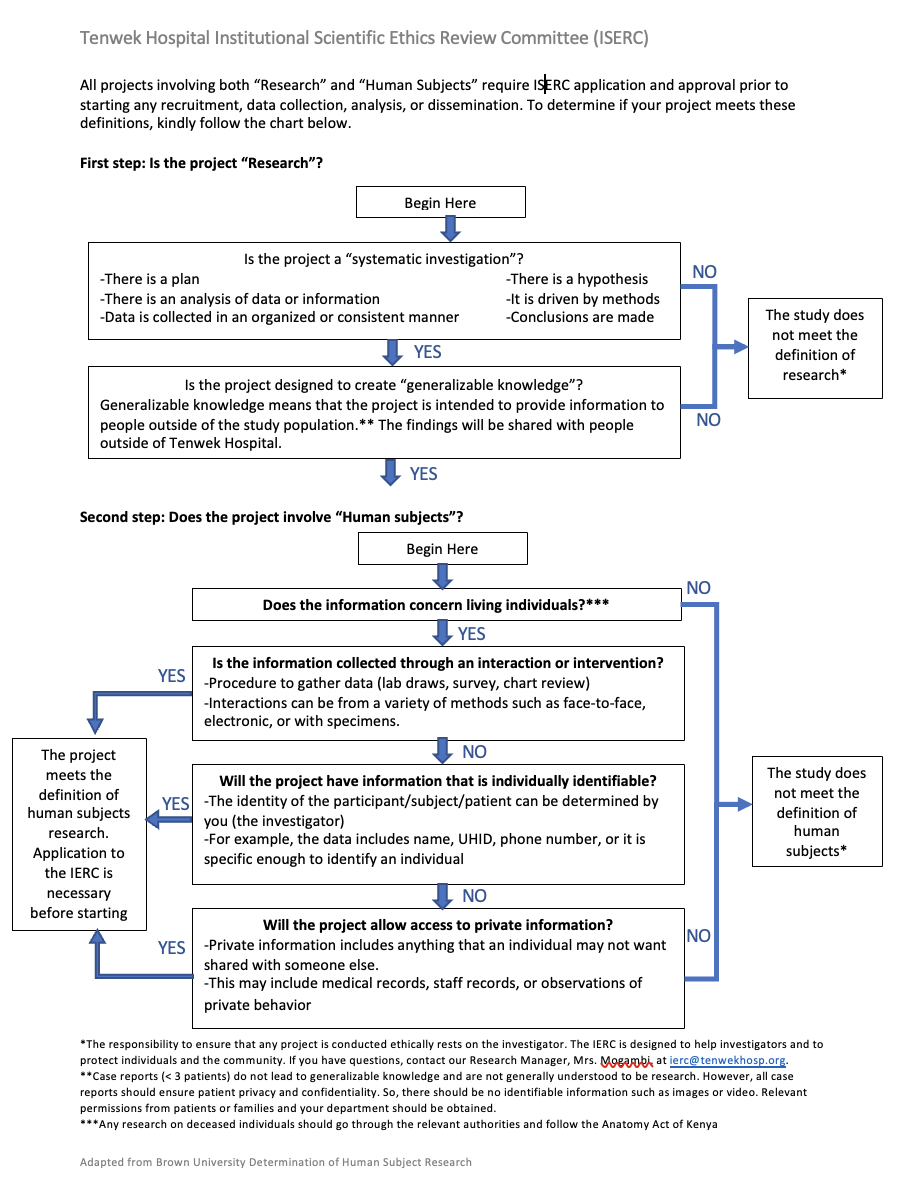
To better appreciate AGC Tenwek Hospital's research guidelines, we first need to clarify the concept of research. Research is a structured (or systematic) way of investigating something to discover or confirm information. When you gather specific data or design a questionnaire, you're conducting this organized investigation. When you share these findings at a conference or in an article, you're broadening everyone's understanding.
At AGC Tenwek Hospital, we often focus on research involving people and, most commonly, patients and staff. This means that we might collect information directly from individuals through methods like interviews, tests, or by examining personal records. For instance, if you create a survey for an academic project, review medical records for a publication, or introduce a new medical method at a workshop, these all fall under human subjects research.
However, it's equally important to recognize what doesn’t qualify as human subjects research. Simply using data for patient care doesn't fall under this category. Activities like discussing patient outcomes at an internal meeting, referencing or looking up established medical information, or giving a talk about a well-known disease without introducing new insights aren't considered research. But, if you decide to share such information beyond the confines of AGC Tenwek Hospital, it might transition into research.
We have developed a guideline to help determine what is defined as research and requires ethical review (Appendix A), but we encourage potential researchers to ask those in the Medical Education and Research Department for advice.
Eligibility and Collaborative Research:
Every staff member within our institution is eligible to engage in research. Collaboration with accredited external researchers or institutions is welcomed; however, it must be formalized through documented agreements that ensure alignment with our hospital's objectives and standards.
To build research capacity, research conducted at AGC Tenwek Hospital or using any data from AGC Tenwek Hospital must have an investigator who is affiliated with AGC Tenwek Hospital. The AGC Tenwek-affiliated individual must be credited as an author and have AGC Tenwek Hospital listed as their affiliation for any publication or presentation (see the authorship guidelines below for inclusion as an author to understand the expectations of the affiliated investigator). If the AGC Tenwek-affiliated investigator does not meet the authorship criteria and the principal investigator does not wish to include them, the study does not have ethical approval. It may not be published or presented anywhere.
Ethical Considerations and Approvals:
Research integrity is paramount. Every research study must secure clearance from our Institutional Scientific Ethics Review Committee (ISERC) before starting data collection. ISERC's ethical review protocol can be accessed on our institutional website, along with the standardized fees that enable review. The National Commission for Science, Technology, and Innovation (NACOSTI) permit is also obligatory and must be obtained by the investigator through NACOSTI.
The AGC Tenwek Hospital ISERC, formed by AGC Tenwek Hospital and accredited by NACOSTI, ensures that every research endeavor respects human dignity and protects the vulnerable. This committee combines experts from diverse fields, including a non-specialist member from the community and a legal advisor. Proper ethical review takes time and resources; thus, investigators should plan accordingly to enable successful review of their project. The average ethical review board takes 2-3 months. At AGC Tenwek Hospital, we strive to complete ethical review within 28 days of a fully complete application. We do not guarantee this timeline; authors should account for potential delays. The standard operating procedures and service charter of the ISERC help to create and fulfill expectations. A checklist is included in Appendix B to help investigators understand part of what the ISERC evaluates.
Informed Consent
Informed Consent is a mandatory requirement for research participants. Committees and institutions require it, especially for studies involving human subjects.
Research ethics hinge on informed consent, which ensures that participants understand the study's purpose, methods, potential risks, and benefits. Informed consent should achieve the following:
● Respects Autonomy: It upholds participants' rights, empowering them to make informed decisions.
● Builds Trust: It fosters a transparent and honest relationship between the researcher and participants.
● Reduces Risks: It minimizes potential legal and ethical liabilities by informing participants of potential hazards.
● Ensures Validity: Research gains credibility when participants are engaged willingly.
Neglecting to obtain informed consent risks invalidating research findings, incurring legal repercussions, tarnishing the researcher's reputation, and causing distress to participants and the community. Each investigator should ensure that their study has appropriate informed consent in the language the participants understand. A suggested template for AGC Tenwek Hospital is available upon request.
Intellectual Property (IP) and Innovations:
Intellectual Property (IP) encompasses the unique creations of the mind, including inventions, artistic pieces, brand symbols, and commercial names or images. In the context of medical research and practice, establishing clear ownership and usage rights for these intellectual assets is essential.
At AGC Tenwek Hospital, we understand the value of innovations and discoveries. These new developments advance the boundaries of medicine and science and may have significant societal and economic implications.
As such, any innovation or discovery formulated within the precincts of AGC Tenwek Hospital is under the purview of national IP regulations. These regulations ensure that intellectual property rights are protected, promoting innovation without fearing unjust appropriation. They grant creators exclusive rights to their inventions, thus providing them with recognition and possible financial benefits.
Our standard protocol dictates that any intellectual property developed at AGC Tenwek Hospital is jointly owned by both the institution and the principal investigator or innovator. This collaborative ownership reflects our ethos of shared growth and mutual respect. It acknowledges the investigator's pivotal role in the innovation while also recognizing the institution's contributions, whether in the form of resources, infrastructure, or guidance.
However, we also recognize that every innovation is unique and may have specific circumstances attached to it. For such distinctive cases, AGC Tenwek Hospital is open to tailored discussions. These might include adjusting terms of ownership, licensing agreements, or any other bespoke arrangement that ensures the innovator's efforts are appropriately credited and protected. Such discussions aim to balance the innovator’s rights and the hospital's interests, always adhering to the overarching principles of fairness, transparency, and respect.
AGC Tenwek Hospital remains dedicated to fostering an environment where innovations thrive, and the rightful innovators are celebrated and protected under the umbrella of intellectual property guidelines within Kenya.
Funding and Resource Allocation:
Given constrained resources for research, we strongly encourage researchers to pursue external funding. External funding sources must be documented on the research application and disclosed when the research is presented or published. A segment of procured funds may be reinvested to enhance our collective research capacity and secure future resources. The Research Unit recognizes the importance of developing shared resources and endeavors to create opportunities for future researchers.
Data Management, AI, and Technology:
In today's digitized environment, the importance of data cannot be overstated. Proper handling and storage of research data are imperative, not only to uphold the integrity of the research but also to ensure the confidentiality of patient and research participant information.
Data Security and Confidentiality: All research data should be stored in secure environments protected against unauthorized access, breaches, or loss. Regular backups must be conducted, and robust encryption methods must be applied, ensuring the utmost protection of data. Researchers must be aware of both the technical and ethical considerations when dealing with sensitive patient or research participant data, ensuring it remains anonymized and de-identified where applicable. Data breaches should be communicated immediately to the ISERC, who will notify the Hospital Management team.
Artificial Intelligence (AI) in Research: The advent of AI, particularly generative models, offers promising avenues in healthcare research. These tools can potentially expedite data analysis, identify patterns or anomalies, and even aid in diagnosis or treatment plans. However, as with all tools, they must be used judiciously. It's essential to ensure that AI models are used ethically and transparently, their results interpretable, and their methodologies rigorously tested for biases or inaccuracies.
Emerging Technologies: Beyond AI, the landscape of technology in healthcare research is vast and ever-evolving. From advanced imaging techniques to bioinformatics tools, integrating these technologies can significantly enhance the depth and breadth of research. However, their use must be rooted in evidence-based practices, ensuring they enhance rather than detract from the research process.
Ethical Considerations: The use of advanced technologies, especially those dealing directly with patient data or interventions, should always be approached with the highest ethical standards. This includes ensuring transparency in methodologies, safeguarding patient rights and privacy, and ensuring that technology is used to align with the best interests of patient care and safety.
In summary, while the benefits of technology in research are promising, they come with their own set of responsibilities. At AGC Tenwek Hospital, we are committed to leveraging these tools effectively, ethically, and responsibly, always placing our patients' and research participants' well-being and safety at the forefront.
Publication and Dissemination:
Research should be shared with the broader medical and scientific community. Our institution values the wide dissemination of research findings. Ethical approval is necessary before starting a project; publication or presentation is prohibited without ethical approval.
We advocate for research findings to be submitted to reputable, peer-reviewed journals in the field of interest. Peer review ensures that the research undergoes rigorous evaluation by experts in the field, enhancing its credibility and reliability. This rigorous process enhances the integrity and validity of the findings, elevating the reputation of both the researcher and AGC Tenwek Hospital. Investigators should avoid plagiarizing others’ works as their own or concurrently submitting manuscripts to multiple journals.
Presentation at national and international conferences, symposiums, and workshops is highly encouraged. These platforms offer an invaluable opportunity for researchers to receive feedback, engage in discourse, collaborate, and network with peers and experts from across the globe. When investigating external funding for research, consider the opportunity for presentation as a potential expense to the budget.
In the spirit of transparency and broad dissemination, we prefer open-access publications (instead of subscription-based journals that block access), ensuring research is accessible to all. While open access is encouraged, researchers should be vigilant about avoiding exorbitant publication fees. Often, genuine open-access platforms have fee waivers or minimal charges for authors from low- and middle-income countries.
The research landscape, unfortunately, includes predatory publishers, who compromise the rigor and reputation of scholarly publishing and charge fees in return for publication. Predatory journals typically do not have high peer review and editing standards but exploit researchers by requesting payment for publication. We urge our researchers to exercise discernment, seeking platforms with a recognized history of excellence, editorial boards, and credible review processes. The Medical Education and Research Department can help determine if a journal is credible.
Adherence to our institutional guidelines is paramount when disseminating information under the banner of AGC Tenwek Hospital. This ensures that the information is accurate and of high quality and protects the reputation and integrity of the institution and the researcher.
All publications involving data from AGC Tenwek Hospital should be sent to the Research Office through the Research Manager.
Stakeholder Engagement and Feedback:
To ensure our patient-centric research addresses real-world challenges, we encourage engagement with patients, their families, and the broader community. Feedback mechanisms will be instituted for researchers, participants, and other stakeholders, fostering continuous improvement in our research processes.
Material Transfer Agreements
Materials are a valuable resource. When it is required, a signed agreement should govern the transfer of biological materials from one institution to another. Such an agreement should follow relevant national guidelines and laws such as review by the ISERC. The agreement should help to foster equitable and shared benefits from any use of the material. A sample MTA may be found on the NACOSTI website
Authorship Guidelines
AGC Tenwek Hospital values proper credit for research contributions. Authorship is granted to those making significant intellectual input, covering project design, data handling, content drafting, and final version approval. Simple resource provision or administrative support does not qualify a person for authorship. Contributors not meeting authorship criteria should be acknowledged separately. Authors must ensure work integrity and declare any potential conflicts of interest. It should be noted that all research conducted at AGC Tenwek Hospital must have an author affiliated with AGC Tenwek Hospital.
Conflict of Interest
Conflict of interest occurs when external factors, personal or financial, jeopardize the impartiality and professionalism in research. This can manifest at any research phase, from design to dissemination. Researchers at AGC Tenwek Hospital must declare any possible conflicts, such as financial ties, affiliations, or personal connections, that could impact research outcomes. The ISERC will evaluate disclosed conflicts, gauging their relevance to the research. If manageable, steps like assigning an unbiased overseer, public conflict declaration, or role adjustments for the involved individual will be instituted. All identified conflicts are documented, with routine checks ensuring policy compliance. Non-disclosure or hiding conflicts breaches AGC Tenwek Hospital's ethical codes, risking repercussions from publication retraction to funding loss or strict institutional penalties. Researchers should consult the Research Office to clarify potential conflicts, emphasizing adherence to AGC Tenwek Hospital's rigorous ethical standards.
Training, Development, and Capacity Building:
Regular training sessions will be held, and resources will be accessible, ensuring our staff remains at the forefront of research methodologies, ethical standards, and global best practices. Investigators should ensure that they have the proper training and mentorship to undertake research projects at AGC Tenwek Hospital. It is the researcher’s responsibility to ensure that they and their team members have the appropriate expertise to conduct the research.
Compliance
Research activities at AGC Tenwek Hospital are guided by stringent ethical, scientific, and clinical standards. These standards are in place to ensure the safety of patients and research participants, the credibility of our research, and the overall integrity of the institution. Violations or failure to adhere to the stipulated guidelines and policies can have significant implications.
If a researcher conducts a study without obtaining the necessary ethical approval at AGC Tenwek Hospital:
The study will face immediate suspension. The researcher may be subject to disciplinary actions, ranging from mandatory training to employment termination. Additionally, any findings from the unauthorized study cannot be published or recognized, and legal actions might be pursued. Furthermore, the researcher's reputation and future research collaboration or funding opportunities may be jeopardized. If the researcher is associated with an educational institution, the university or training program will be notified. The response from AGC Tenwek Hospital must protect the patient's identity and safety, the community, and the institution.
Individuals who report concerns about non-compliance will be protected against any form of retaliation or adverse consequences. The confidentiality of the whistleblower will be maintained to the extent possible.
Management Oversight
Research is overseen by the Medical Education and Research Department, which reports to Management through the Director of Medical Services. If these policies do not cover issues, Management, in consultation with the Research Unit, will be called upon to provide direction.
Policy Review and Governance:
This policy is dynamic and will undergo biennial reviews, or as needed, to adapt to the ever-evolving research landscape. The Board of AGC Tenwek Hospital, guided by the Subcommittee on Education, Training, and Research in consultation with the research unit, will be responsible for these reviews.
By abiding by this policy, AGC Tenwek Hospital aspires to remain a beacon of excellence in medical research, setting benchmarks nationally and globally while remaining rooted in our core mission of patient care, service, and ministry.
Appendices and Resources:
A. AGC Tenwek Hospital Decision Tree for Research